All posts by Nick Travers

7 Ways to increase your re-tweets & likes

Ever wonder why reciprocal users are not re-tweeting and liking more of your content?

Avoid these seven basic errors that limit the potential of your brand on Twitter:

 

No original contentNo original content:  On the
internet, content
marketing is king.  If you are not providing something interesting/engaging/useful/quirky for your customers to read or see, you might as well be screaming into the wind.  Get some content out there and  link to it on your twitter posts.

Not enough original content:  On twitter, one of the most common ways to say thank you for a Follow, Like, or Retweet, is to return the favour and Follow, Like, or Retweet the person back.   A Follow for a Follow is no problem.  However, Twitter will only let you Like and Retweet each tweet once.  So if you retweet six of my tweets, but only have one original tweet of your own, I can only Like it once and Retweet it once.  That means you miss out on five Retweets and five Likes that I would like to have done for you.  You can’t build up a reciprocal relationship without having sufficient material available, so tweet more stuff – even if it is the same stuff tweeted over and over again.  See my article on twitter marketing to discover how you can easily automate this (link to interesting/useful content).

No pinned tweet: The easiest way to ensure someone re-tweets your best content in a tweet, is to pin it to the head of your twitter stream on your profile page as a pinned tweet.  Select a tweet and click on the three dots (…), and select “Pin to your profile page” from the dropdown list. Job done.

Old pinned tweet: Remember what I said about twitter only letting you re-tweet and like a tweet once?  Well that also applies to your pinned tweet, so replace it often, either with an identical copy-and-pasted tweet or with more original content.

No Media content:  After the pinned tweet, the next easiest place to find original content is under the ‘Media’ tab.  Every time you attach media to a tweet, such as a picture, it appears under the ‘Media’ tab.  Unlike the ‘Tweet ‘tab, re-tweets and likes do not appear under the ‘Media’ tab.  This means every tweet appearing under the ‘Media’ tab is an original tweet from the originator.  So make it easy for your content to be discovered and attach a picture to every content tweet.

No multi-media content:  Videos, gifs, mems , cartoons, and photos can all act to catch the eye of a user as they scan down their twitter feed at break-neck speed.  Yes, it does all take time to set up, but once you have created a basic number of quality multimedia tweets you can recycle them an infinite number of times simply by cutting and pasting.

No automation:  To avoid spammers, twitter allows only a very limited amount of automation.  Use what there is, it’s a lot quicker than cutting and pasting. Regularly recycle your multi-media tweets that contain quality content.  Use service like Buffer and you will soon fill your ‘Media’ stream with masses of easy to find original content.

Follow these simple rules and you will soon increase the number of re-tweets and like from reciprocal user.


European Debate – A right Buggers Muddle

This is an update to my Britain Sleepwalks Out of The EU post of the 8 March 2016:

One thing becoming painfully obvious as this campaign progresses is that most British people have no idea how, as a country, we relate to the EU, and those who support leaving have the least idea of what they are actually wanting to leave:

I have heard people say that once we are out of the EU we will not need to contribute to NATO any more, but our membership of NATO is in no way linked to our membership of the EU.

This morning on the radio I heard a government minister say that outside the EU Britain would be safer because the European Court of Human Rights could no longer interfere with our laws.  Intense dislike of the European Court of Human Rights is common among leave supporters.  Unfortunately the European Court of Human Rights  is not an EU institution and leaving the EU would have no effect on its ability to influence out laws.  The European Court of Justice is an EU institution, but it does not make judgements on human rights.

I have even heard someone looking forward to the return of the British pound note – as if that will ever happen.

More seriously, if as a country, we vote to leave the EU, it is clear that many people will have little idea of what they have actually left.  They may in fact  be very disappointed that the things they most hate about Europe are still with them.

If we remain, it is equally clear we will need to improve our education about what the EU actually is and what it is not.

God help us all.

Author Cooperative

Since my last post I  have been challenged as to what an author’s cooperative might look like.

Now  this could, in my naivety, turn out to be the greatest work of fiction I have ever created, but here goes:

The biggest problem I face running a business as a lone indie author is not having time to write new book because I am too busy marketing the ones I have already written.

The second biggest problem I face is momentum:  I simply cannot publish books quick enough to give the brand sufficient momentum to keep it in the public consciousness or more importantly, in the consciousness of my readers, who rapidly move on to other books and authors.

The third biggest problem is cost: To market successfully I need to pay annual fees which I am not guaranteed to earn back through book sales.

The fourth is ineffective marketing: Whilst I am happy to do the work, I really need an expert to tell me what to do.  However, everyone requires an up-front fee, which doesn’t actually guarantee any sales and which I am not guaranteed to earn back in book sales.

So my ideal business model would be: a marketing expert who sets things up, tells me what to do, and who takes a percentage of each sale; other authors to help give a niche brand/imprint real momentum and keep costs down by splitting annual fees; less time spent marketing and more time spent writing new novels.

I may be wrong, but successful businesses on the internet seems to rotate around  either around  having loads of money to create a big brand, getting very lucky by having the right idea at the right time in the right place, or very narrowly targeting a small niche. As I have no money to create a big brand and believe in creating my own luck by working hard, I follow the niche model.

So this is my niche cooperative idea: Six authors, who all publish in the same niche, come together to market their books.  Each author has had their work edited, proofread, formatted, and cover designed.  In other words, they have created the best quality product they are capable of producing.

Central to the cooperative is the seventh member of the team:  the marketing director. This is the person who gets a kick out of marketing and knows how to market books. They create a WordPress website for the niche/imprint from where all the author’s books are sold; they arrange the book tours, guest blog appearances, research content for the blog/website, organize the book launches, and  pull together the marketing strategy for the niche/imprint.  Basically, this person tells the authors what to do and what content/articles to produce.  In return for this key role, they get 40% of every book sale; the authors get 10% each.

Here’s an infographic of what I envisage:


Cooperative

Why six authors? Apart from making the math easy, assuming each amateur/part-time author takes a year to produce a new book that means the niche/imprint has a new book launch every six to eight weeks – now that is the sort of momentum a brand really needs.  Also, if Paypal is used as the payment platform they have a six person parallel payment limit (see below).

Each author would be free to still market their own books individually, however they like, (including titles offered through the cooperative) outside the cooperative and publish on Amazon, Smashwords, Kobo, B&N etc.  Books in the cooperative arrangement would be sold  purely from the niche/imprint website. Each author would publicize the niche/imprint website, the cooperative titles, and the cooperative website content/blog, via their chosen social media platforms in line with the marketing strategy devised by the Marketing director.  Each author would take 10% of the profit from each ebook sold via the website, regardless of whose title it is, and the Marketing Director would take 40% of each sale.

There are of course two weak links in this business model:

The platform: A purchasing merchant services app would  be required that could automatically divide up payments.  If Paypal were used as the main payment system, they have two options: Parallel payments (maximum 6 recipients) and Chained payments (maximum 9 recipients), either option which do the job. To run such a system the cooperative would need to pay an annual fee for a WordPress.org  website and pay for a Paypal Business Account.

Scaleability:

The fan/reader would have a steady supply of new titles in their niche of interest.

For the armature/part-time writers, scaleability through the cooperative comes from time freed up from marketing to write more book titles in a series.

For the marketeer, scaleability would come from building up expertise and expanding to form additional niche imprint cooperatives:

Cooperative scaling

This business model is based on everyone putting in hard work to earn a living wage: it is not a ‘get rich quick’ scheme for anyone.

The best way to set up such a cooperative would be for the Marketeer to set everything up and pull each niche cooperative together.  Will this business model make enough money for the Marketeer?   Does this business model interest any Marketeers?  Is there anyone out there who sees possibilities in such a business model?  Is there anyone out there will to give it a go?


Indie Online Publishing Model

We all know what it takes to be a successful Indie author: A series of good online books, a large online following, regular interest articles on your blog, regular and frequent social media contact with your followers, a regular supply of new titles, a marketing funnel, plenty of time for marketing.

A regular supply of new titles and plenty of time for marketing are, of course,  the most difficult to deliver, because they conflict with each other: the time I need to  write new novels in a series is also the time I need to use to market the existing ones.

The ideal for any author is to pay someone else to market for them.  Unfortunately, the only people willing to do this require an up-front flat fee rather then being happy to take a percentage of the purchase price.  Even it they were only willing to market the book for six months after publication, it would help me to produce the next novel in that time period.

I tried offering a 50/50 associate program to anyone willing to market my books, but after nine months there were still no takers, so I have scrapped the program.  Perhaps I should have offered an 80/20 split.

I have recently come across an online publishing company called ‘Wizzards Keep Publishing’ which appears to offer exactly what I’m looking for, but I doubt their ability to achieve anything.  Why?
Well, it is all a matter of scale.  Let me explain.

WKP offer to market to their 50k twitter fans. As I have mentioned in previous articles, the stats point to any author needing a minimum of 50k followers on twitter, so that number for an online book marketing business is woefully small.

To succeed with a percentage marketing model, WKP would need 500k or 5M followers and a steady supply of new titles vetted by themselves for quality.  More accurately, WKP would need an emai list of 50K people who trust them to deliver quality books in a specific genre and style.

To build an online business of this magnitude would require a huge amount of seed money – $500k, $2M, $5M?  And the payback for such a business model would be a long way down the line.  WKP has already changed hands once in its short lifespan and currently have a relaunch crowdfunding campaign to raise $5,000.

I wish them success, I do, I really, really do.  I just don’t see the scale here that I believe is required to succeed.

With my 10.6k twitter followers, my minimal automation, my slowly developing blog/website, I think I will struggle on trying to both market and write at the same time.

If there is an alternative way forward for me, I see it only in terms of forming a cooperative: like minded authors coming together to market their books so each can spend a little less time marketing and a little more time writing.

So, if you are writing fiction novels in the Dystopian/Steampunk genres, are committed to writing more books in those niche genres, have a reasonable following on social media and are committed to actively gaining even more followers, contact me and we will discuss cooperation.

Nick.

Sucking the Soul from Writers

A few weeks ago I was approached by someone onwriter_vampire_by_night_mouse_pad-r4f54d97533a64dbca50ffaee1da78fc9_x74vi_8byvr_324
Twitter asking if I wanted to contribute to an ebook where writers write about their marketing experiences and give tips on how to market books better.  All the contributors would then promote the ebook and take a cut of the profits.

On the face of it, this sounds like a good business model: lots of people contributing to something that lots of people then market and everyon
e shares in the profits.  And it’s scalable too, because you can produce a whole series on ever aspect of writing – maybe even branch out into comics and film.  The possibilities are endless.

At first I was flattered that I had been asked.  Then reality struck: this is just another way for writers to make money from fellow writers, or even worse, wannabe writers.  This is jumping on the back of the gold rush and making profit by sucking the soul out of those searching for creative gold.

Let me tell you that making a living out of novel writing is hard – anyone who says otherwise is trying to sell you something.  Call me stupid, and the person who offered me this opportunity probably will, but I prefer to make my living out of actually crafting novels.  Which is why all the writing tips and ‘how to articles’ on this site are free.

vampire_fangs_mouth_4cf648bedf247It seems that anyone who completes the first draft of a book can call themselves an expert, and write an ebook to sell to other would be writers.  In my humble opinion, most of these books are not worth the money you pay for them.  There are a few brilliant exceptions, but only a handful.  A writing tutor can not only get to the heart of the craft, but they can inspire others.  The good ones invariably give lots of advice away for free to new and wannabe writers, because they know how hard it is.


My advice?  Join a library, read what you can for free to get you started.  Surf the internet, there is loads of valuable free advice available from expert writers.  If you have a specific problem with your writing, save your money for a writing cours,e where you can get specific one-to-one advice from a tutor who reads your work.

Sorry, this turned into a bit of a rant.blood-splash_1502144Nick

Britain Sleep Walks Out of Europe

I don’t normally talk politics on this blog, but I feel compelled to comment about the forthcoming poll on whether Britain should remain in the European Union.

Update 19/4/16: One thing becoming painfully obvious as this campaign progresses is that most Britain’s have no idea how we relate to the EU, and those who support leaving have the least idea of what they are actually wanting to leave:

I have heard people say that once we are out of the EU we will not need to contribute to NATO any more, but our membership of NATO is in no way linked to our membership of the EU.

This morning on the radio I heard a government minister say that outside the EU Britain would be safer because the European Court of Human Rights could no longer interfere with our laws.  Intense dislike of the European Court of Human Rights is common among leave supporters.  Unfortunately the European Court of Human Rights  is not an EU institution and leaving the EU would have no effect on its ability to influence out laws.  The European Court of Justice is an EU institution, but it does not make judgements on human rights.

The most common misnomer, of course, is that we will be able to control our own borders once we are out of the EU because we will not have to allow the free movement of people throughout Europe.  But actually, we are not signed up to that part of the EU treaties that allows for the free movement of people, so we already control our own borders.    In that respect nothing will change if we leave the EU.

If, as a nation, we do vote to leave the EU, it is clear many people will have no understanding of what we have actually left, and may be disappointed that the things they most want to leave behind are still with us.

If we stay in the EU, it is clear there will have to be much better education of what we actually belong to and the limits of the EU organisation.


It is really difficult to filter out the issues that really matter, because the headline issues, pushed by either side of the debate, are largely irrelevant:

Migration will change little if we leave the EU, any decent trade deal is bound to require the free movement of EU citizens. And everyone else is coming from parts of the world which we have helped to destabilize with our military action. Even those coming from sub-sahara Africa would traditionally have stopped in Libya before we helped destabilize it – now they carry on to Europe. As we bear some responsibility for the mess their nations are in, we would still have to take them in.

The economy would undoubtedly suffer in the short term, both from trade tariffs and uncertainty while new trade deals are hammered out.  In the longer term we would cope: there would be no option, so we would make it work.  Would we be more prosperous without the drag anchor of Europe or less well off due to limits on free trade with Europe?

No one knows. Probably the effects would be about equal out in the long term.


Some things will stay the same no matter what decision is made:

Defence will still be tied up with Europe because we will still be part of NATO.

Diplomacy will also largely be tied in with NATO and therefore Europe.

If we wish to still trade with the EU, we will still be bound by their red tape and bureaucracy.


Some things though will suffer:

Research and development is a big one.  Without any natural resources to speak of, Britain is dependent on trade.  These days that amounts to trade in money, trade in financial services, and technological advancement.  Without massive investment in R&D Britain will fall behind.

However, I hear no one talking about this or putting forward a plan for R&D in a non EU Britain.


There could be opportunities:

Data is the natural resource of the future, something Britain can really call their own if we get ahead of the curve, especially in banking and financial services, but also in other areas too.  With a culture of innovation and entrepreneurial start-ups, Britain ought to be able to sprint ahead without the constraints of the EU.

Again, I hear no one talking about any of this, no plans for the future.


The one thing that could sway me to vote to leaved the EU:

If someone puts forward a vision for the future for Britain that is really positive, dynamic, and radical, that addresses the issues I have mentioned above, but is not currently possible because of European constraints, I could be swayed.

I am not hopeful.


A bleak campaign: 

I see no groundswell of political change, no desire for a new economic direction, no appetite for radical reform, no compelling vision of a future Britain.  Nothing, in fact, except a desire to be free of European interference – which will never happen whichever way the vote goes.

If the best argument for leaving the EU is pure frustration, we should stay in and change it from the inside.

In fact, given that all the opposition parties, except UKIP, and half the government, are against leaving the EU it is difficult to see who could possibly put forward a realistic alternative vision for Britain without tearing the ruling Conservative party to shreds.  Except, maybe, Boris Johnson.

It really made me think when Boris opted to joint the out campaign, but in reality he has contributed very little.  He is almost certainly playing party politics: If the Out campaign wins, he will probably be Britain’s next Prime Minister – the person who will have to navigate extracting Britain from the EU; if the In camp wins, then he has done himself no political harm and may have made some useful allies. All Boris has done so far is sit on the sidelines and made the odd semantic observation.  His heart is not really in it.

If Boris really believes in a better Britain without the EU, he is the one person who could, and should, present a new vision for Britain.

But he won’t.


Book sale

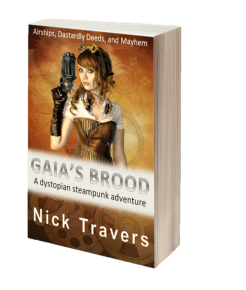
Gaias Brood Gogs Dec 2014

In the spirit of continual experimentation, to find the best price for my books I have just reduced the price of all my books on Amazon.

Gaia’s Brood is now $1.99

Helium3 are each $0.99 each

Helium3 Box Set is $1.60 – a HUGE saving of $0.38 on the cost of purchasing each book separately.

So if you have been thinking about buying any of these books, now is the time to purchase.

Nick

The sound of black holes colliding

Two black holes, the most powerful forces in the universe, collide and emit gravitational waves.

Hollywood would have them crash together with the most thunderous sound ever heard.

But the actual sound of the gravitational wave: Bloop.

A simple, elegant, pure, even beautiful, bloop. Like a pebble dropping into a deep deep well, Which in an astrophysical sense it is.

In fact, it was so elegant I laughed.

The most powerful sound in the universe:

Bloop.

Make money while writing a novel

pakistan-online-earnEarning while writing your next novel has to be the holy grail of authoring.  Surely, in the age of the internet, it must be possible to earn money chapter by chapter as you write a novel.  For me, this intriguing possibility reared its head when I came across Freemium publishing in China.  Readers of Freemium pay per character to read the latest instalment of their favorite series.  The best writers publish up to ten thousand characters daily and earn good money.  Unfortunately, this only works with serials written in Chinese characters—I know because I have tried to publish on Qidian.com, but it just does not work.
There is no equivalent earn-as-you-write platform anywhere else in the world except Japan.

While I was writing the first book in my Dystopian Steampunk series, Gaia’s Brood, I did manage to make $30 per month.  I published two chapters per week on Jukepopserials.com.  At the time they were awarding $30 per month to stories that received the most reader votes in each of their genre categories.  I had no problem topping the Steampunk genre month after month.  I would do the same again with my current novel, Coggler’s Brood, but Jukepop Serials have moved onto a different reward model.

Now monthly genre winners receive credits towards a sort of crowdfunding system where internal investors contribute towards the costs of publication and marketing, then share in the book profits.  Not a bad model, and will be interesting to watch for the future—you should definitely go and check it out.  However, it is not what I am looking for at the moment.

maxresdefault Instead, I am experimenting with a platform called Patreon.com, a crowdfunding site where investors are encouraged to pay one or more dollars per month as a patron of a particular artist/creator. In return, investors are given rewards, in my case a free electronic copy of my ebook if they contribute $1 per month or a paperback copy if they contribute $10 per month.

In all cases contributors will receive access to restricted chapters as I write them and in the future access to restricted stories.

For the moment, I am offering chapters of Coggler’s Brood for free as I write them, but before long, I will restrict access so only contributors on Patreon.com will be able to access them.  I will still be publishing work in progress chapters on my website, but again, these will be restricted by password, where the password will only be available via Patreon.com.

In fact, before long, you will only be able to view my work-in-progress by contributing at least $1 per month on Patreon.com.

Will it work?  Will anyone be interested enough in my work-in-progress to contribute anything on Patreon.com?  Who knows, I will report back on progress in the future.

In the meantime, if you would like to become a patron of the arts, you can contribute as little as $1 per month at Patreon.com


Please support the work of this writer by buying his works, pledging a monthly amount in return for rewards, or by donating below via Paypal.

Donate Button

Steampunk or Steampulp

o-steampunk-writer-facebookRecently I have been challenged on whether I can correctly use the term ‘Steampunk’ when referring to my novels Gaia’s Brood and Coggler’s Brood.

Am I misusing the term Steampunk in my writing?  Am I, like many authors, just jumping on the Steampunk bandwagon?  In fact, has Steampunk become no more than a marketing term?

Steampulp is a new one on me, but I do have to confess to liking the term.  I am not ashamed to admit that I write pulp fiction.  In fact, I rather take pride in the title: to me it means popular, fun, literature that is produced by someone working hard at their craft.  It also suggest that stories are produced as a series.

Just because I am churning out pulp serials does not mean I am not also, in some small way, trying to challenge concepts, taboos, or accepted culture.  I am fascinated by the reasons people do things, so I try to examine this in my novels.  The stories in Gaia’s Brood and Coggler’s Brood are very much character driver:  Why is Nina Swift obsessed by the mother who abandoned her?  How far will Nina go morally to prevent a massacre?  To what extent will Fernando rebel against his family before he is reined in by the need for their money?  How does Scud’s simple black-and-white view of the world affect the

As I have said in a previous article, the internet has ushered in a new golden age of serialized (or pulp) fiction.  Any writer, by sheer hard work, can now use the world wide web to bypass the publishing industry’s gatekeepers, build an audience, and make money from writing.  The internet also allows authors to service readers with niche interests, who are perhaps ignored by traditional publishers in their thirst for works with mass appeal.  A genuine readership of 4000 fans should be enough for any author to make a reasonable living, provide they keep churning out the stories their readers like.

Technically, I should not even be using the term ‘Steam’ in my writing, since in the post-apocalyptic, post carbon fuel, dystopian future I use as the setting for Gaia’s Brood and Coggler’s Brood, steam power features hardly at all.  It would be more accurate for me to term my novels Post-apocalypticpunk, Dystopianpunk, or, Ecopunk (have I just invented a new genre?), though, to be fair, I do use the strap line ‘Dystopian Steampunk’.

Except that these terms are far too specific to reach the audience I am attempting to reach.

As for the ‘Punk’ in Steampunk it suggests a general sassiness on the part of the main heroine, Nina Swift, rather than having anything to do with the anti-establishment music scene of 1970’s and ‘80’s.  Many of the characters in my novels have this pop-culture sassiness of character, that you might associate with steampunk comic-strip or cosplay characters.

For Gaia’s Brood, when I was originally writing the book as a serial, on Jukepop Serials, I just called it dystopian fiction, but then it got adopted by steampunkers looking for something new to read.  So, like any good artist, I started to deliberately add in steampunk themes, fashions, architypes, and tropes, to satisfy my readers.

In a very general, genre-based sense, Steampunk suggests a retrograde scifi story without masses of future tech.  I have written before about the problem of including future tech in your stories that then become dated even before the novel is published.  For me, this partly explains the emerging popularity of ‘Steampunk’ stories, both among writers and readers.  Who want’s their escapism ruined by the encroachment of reality?  There is far too much tech stressing us out in real life to also desire it in our fantasy worlds – escapism should be a shelter from the stresses, strains, and anxieties of the real world.

So, back to the original question:  Steampunk or Steampulp?  I am very happy to use the term Steampulp, though, it would rank very low on search engines and need, I feel, more explanation than the term Steampunk.

However, given that ‘Steampunk’ was originally a tongue-in-cheek term coined to describe a very loose collection of retro-futuristic scifi writings that did not easily fit into any other genre, I still feel justified in using the term to describe my retro-futuristic dystopian novels.

So, I do not think I am misusing the term Steampunk to describe my writings.  And yes, I am jumping on the Steampunk bandwagon, because I feel it is a response by the scifi genre to rampant technological advancement.  And yes, of course it is all about marketing, and branding, and finding an audience – because the only thing worse than being a Steampunk writer, is being a Steampunk writer without an audience.


Please support the work of this writer by buying his works, pledging a monthly amount in return for rewards, or by donating below via Paypal.

Donate Button